
Quadriceps Malalignment: A Neglected Anatomical Driver of Patellofemoral Disease
Quadriceps malalignment is a concept that has developed out of research on three-dimensional anatomy performed by Dr Simon Talbot over the last few years.
Quadriceps malalignment describes a mismatch between the line of pull of the quadriceps muscle and the flexion axis of the knee. This creates an unbalanced force vector on the patella which leads to abnormal biomechanics. This can produce lateral patella osteoarthritis, recurrent patella instability and poor outcomes after knee replacement.
Accurately measuring this force vector and describing its clinical relevance it has changed the way we think about patellofemoral biomechanics and created several areas of controversy.
Published Research by Dr Talbot related to Quadriceps Alignment
-
Quadriceps tendon malalignment is an independent anatomical deformity which is the primary abnormality associated with lateral facet patellofemoral joint osteoarthritis
-
Preoperative quadriceps malalignment is associated with poor outcomes after knee replacement which are avoided by external rotation of the femoral component
-
Chronic lateral patella tracking is strongly associated with quadriceps external rotation in relation to the femoral shaft and not with wasting of the vastus medialis
- Further publications are pending and will be updated as able. For updates and full text requests please use Contact page or access ResearchGate at https://www.researchgate.net/profile/Simon-Talbot-2?ev=hdr_xprf
- Regular updates on research are also available on Dr Talbot’s LinkedIn account (https://www.linkedin.com/in/mrsimontalbot/?trk=nav_responsive_sub_nav_edit_profile)
- Quadriceps Malalignment YouTube channel (https://www.youtube.com/channel/UCT87eoYb7Dp5bVHA99LqjPQ)
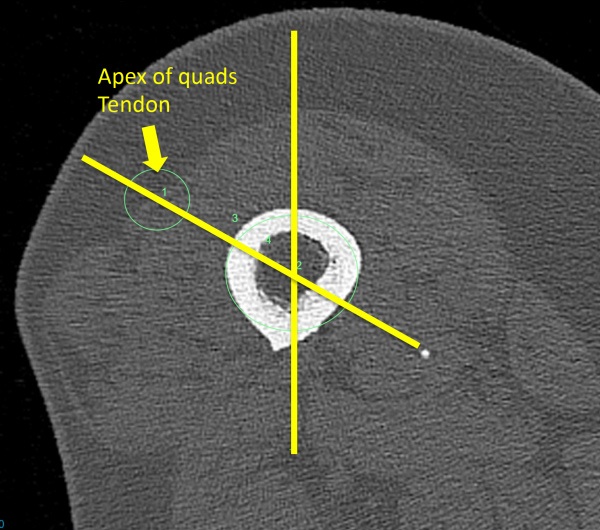
How to Measure Quadriceps Alignment
The muscle alignment can be measured directly but this requires thigh scans. A simpler technique is to measure the alignment of the quadriceps tendon relative to the knee joint. Lateralisation of the proximal end of the quadriceps tendon is an indicator of an unbalanced lateral force vector. The techniques are described in detail in the papers above and in the YouTube videos.
Why Quadriceps Alignment Matters
The quadriceps is the primary driver of patellofemoral biomechanics. Small changes in the alignment of the quadriceps force vector can produce large changes in the lateral force acting on the patella. By analyzing a large number of three-dimensional scans of quadriceps muscles and tendons we have made several important observations
Quadriceps alignment is highly variable
The first cases of quadriceps malalignment were identified serendipitously while measuring three-dimensional scans looking for variations in boney alignment. We identified several cases in which the alignment of the quadriceps tendon was severely malaligned. After analyzing 110 scans of patients with normal knees we were able to identify a huge range in the coronal and axial alignment of the proximal quadriceps tendon.
Quadriceps malalignment is not due to changes in the shape or alignment of the bones
In the normal population study there was no association between the shape of people bones and the amount of malrotation of the quadriceps muscle. It was not influenced by some of the bone malalignment which we might have expected including femoral torsion, femoral neck anteversion and posterior condyle alignment. In particular it was not associated with the alignment or shape of the trochlear groove – which is surprising as the accepted wisdom has been that the alignment of the groove should develop in response to the movement of the patella. These findings have been reinforced in later studies and have important implications for several areas including knee replacement component design and personalized alignment techniques for knee replacement, patella instability and theories on the development of patella osteoarthritis.
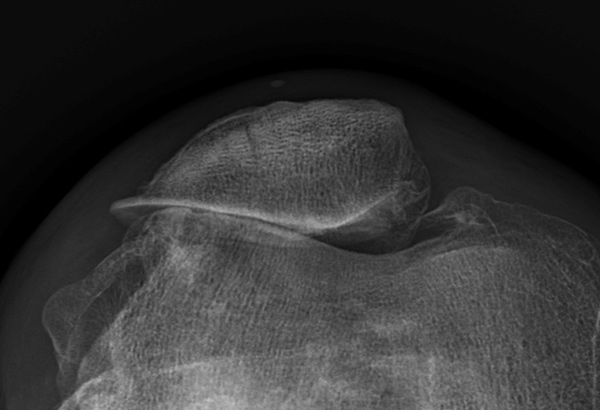
Quadriceps Tendon Malalignment Is Highly Clinically Relevant
We looked closely at quadriceps alignment in two groups of patients – one with severe lateral patella osteoarthritis and one without. The group with lateral patella OA had much more externally rotated (lateralised) proximal quadriceps tendon. This fits with the hypothesis that malalignment of the quadriceps muscle and tendon is causing increased pressure on the lateral side of the patellofemoral joint resulting in the development of osteoarthritis. This challenges some of the current assumptions regarding the development of patella osteoarthritis, particularly the role of trochlear dysplasia (here are recent letters written regarding this controversy).
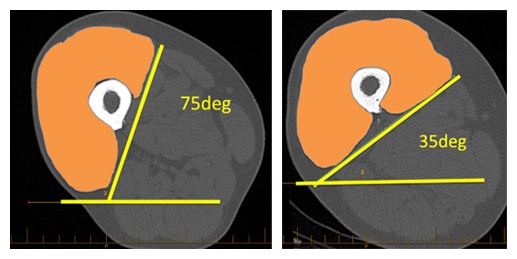
Quadriceps Muscle Malalignment Is Due to a Deformity in the Muscle Which Extends All the Way From the Knee to the Hip Joint
It is not just a malalignment of the quadriceps tendon – though measuring the quadriceps tendon alignment is a reliable surrogate for quadriceps muscle deformity. The muscle deformity can best be described by a rotation of the proximal muscle relative to the femoral shaft and knee joint. The range of rotational malalignment is at least 75 degrees. There are clear differences in the relative shape and alignment of the four components in of the quadriceps. It is also not caused by wasting of the vastus medialis components – which was actually 15% larger in patients with laterally rotated quadriceps. This challenges the long-held belief that patella maltracking is caused by weakness of the VMO – instead it appears to be a rotational malalignment of the entire quads.
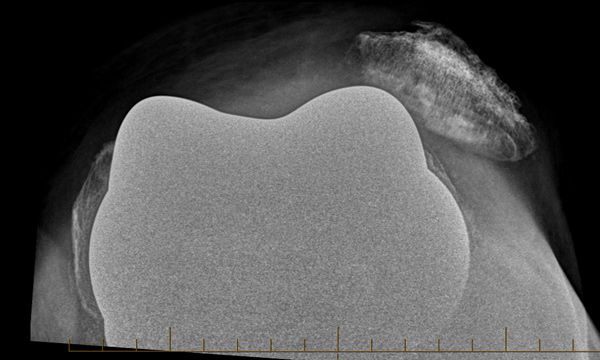
Quadriceps Malalignment Is Associated With Worse Outcomes After Knee Replacement
By reviewing 388 knee replacements and identifying 76 with preoperative quadriceps malalignment we showed that patients with quadriceps malalignment had reduced patient reported outcomes after total knee replacement. We also showed that among the patients with quadriceps malalignment the ones who had more externally rotated femoral components did better than the ones with less rotation. This makes biomechanical sense as external rotation of the femoral component with reduce the imbalance caused by the mismatch between eh quadriceps alignment and the flexion axis of the knee.
This is controversial as discussions about personalized alignment techniques for knee replacement have focused on reproducing the preoperative anatomy by avoiding rotation relative to the posterior condyles (Kinematic Alignment) based on the, now shown to be false, assumption that the Patella Axis of the knee is always perpendicular to the posterior condyles. This assumption was made by measuring the average alignment of the trochlear groove to the posterior condyles – but as we have noted above it turns out the alignment of the quadriceps muscle and extensor mechanism is not linked to the alignment of the trochlear groove.
We are developing an adjusted alignment algorithm to use in patients with preoperative quadriceps malalignment (patent pending).
Quadriceps Malalignment Is a Major Anatomical Risk Factor for Recurrent Patella Instability
By comparing a group of young patients with recurrent patellofemoral instability to a group without PFI we have shown that quadriceps malalignment is very strongly associated with dislocation. The strength of the association in our study was stronger than the association with other accepted risk factors such as trochlear dysplasia, femoral torsion, patella alta and lateralised tibial tubercle. This is due to the lateralised force vector overcoming the static bony and soft tissue constraints. This is likely to be an important factor in the success of both non-operative and surgical treatments for patella instability and should be considered in future research. (publication submitted)
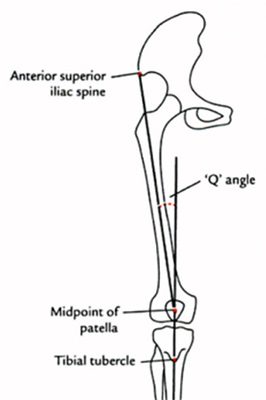
The Q Angle (Quadriceps Angle) Is Not a True Measure of the Force Vector of the Quadriceps Muscle
For decades the Q angle has been the assumed force vector of the quadriceps even though it has not been shown to be clinically relevant. The Q angle uses a two-dimensional line from the pelvis (insertion point of rectus femoris) to the patella. This ignores the three-dimensional shape of the muscle and the fact that three-quarters of it attaches in the thigh and not to the pelvis. Our research has shown that there is no association between the Q angle and the three-dimensional alignment of the quadriceps and that the three-dimensional measurements are clinically relevant.
Ongoing Research
Identification of the three-dimensional force vector of the quadriceps and its clinical relevance has led to a large amount of research interest in the fields of knee surgery, biomechanics and physiotherapy. There are currently multiple international studies underway to assess the biomechanical implications and clinical consequences. There is still a lot more to do and if anyone is interested in undertaking research in this area I am very happy to be contacted if any advice is needed via [javascript protected email address]
I am also happy to present on the topic to interested groups either virtually or in person depending on availability.
- Further publications are pending and will be updated as able. For updates and full text requests please use Contact page or access ResearchGate at https://www.researchgate.net/profile/Simon-Talbot-2?ev=hdr_xprf
- Regular updates on research are also available on Dr Talbot’s LinkedIn account (https://www.linkedin.com/in/mrsimontalbot/?trk=nav_responsive_sub_nav_edit_profile)
- Quadriceps Malalignment YouTube channel (https://www.youtube.com/channel/UCT87eoYb7Dp5bVHA99LqjPQ)